
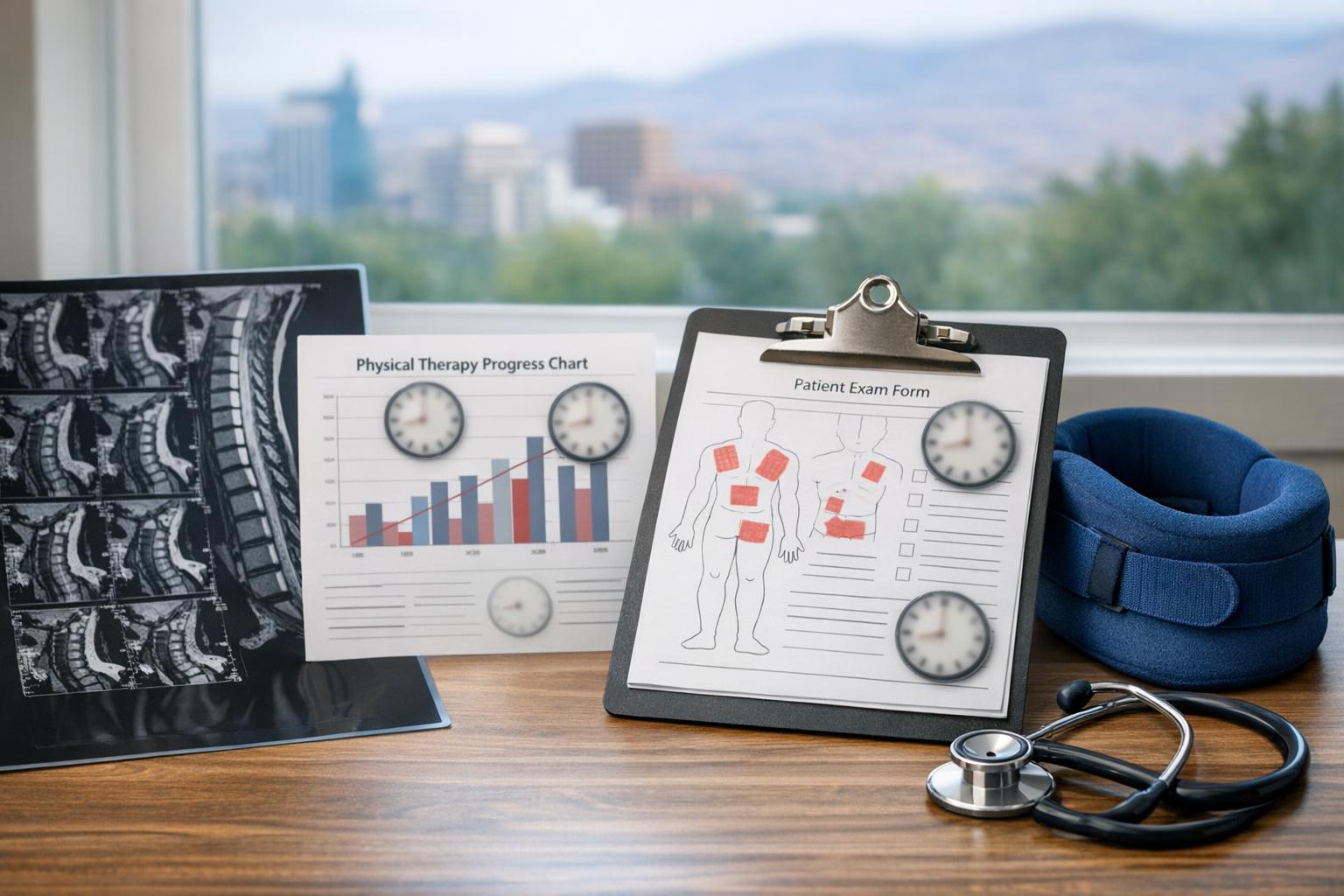
Why “proof” matters more than pain—and how to document it the right way
If you’re dealing with neck/back pain, tingling, headaches, or reduced mobility after a crash in Boise, you’re not alone—and you’re not imagining it. The challenge is that insurance companies often treat soft tissue injuries (sprains/strains, whiplash) and even herniated discs as “subjective” unless the documentation is consistent, timely, and medically grounded. This guide breaks down what typically strengthens “boise herniated disc soft tissue proof” in real-world claims and what can weaken it, so you can protect your health and your case.
1) The two kinds of “proof” that matter: medical proof and timeline proof
Most injury claims rise or fall on two tracks that should match each other:
Medical proof: exam findings (range-of-motion limits, tenderness, spasms), imaging when appropriate (MRI for discs), referrals, and consistent treatment notes.
Timeline proof: a clear sequence from crash → symptoms → evaluation → follow-up care, without long unexplained gaps or major contradictions.
2) What makes soft tissue injuries “real” to insurers (and juries)
Soft tissue injuries don’t always show up on X-rays, and MRIs aren’t automatically ordered for every strain or whiplash case. That’s why clinical documentation is often the center of proof:
Objective exam notes: reduced range of motion, muscle spasm, positive orthopedic tests, gait changes, strength deficits.
Consistency over time: the same pain pattern appearing across primary care, urgent care/ER, PT, and any specialists.
Functional impact: work restrictions, missed shifts, difficulty lifting, driving, sleeping, or turning your head—documented in medical notes (not just in a personal journal).
3) Herniated disc proof: imaging helps, but causation still has to be shown
A herniated disc on an MRI can be powerful evidence—but insurers frequently argue it’s “degenerative” or “pre-existing.” Strong claims don’t just show a disc issue; they show why the crash caused symptoms and treatment.
Documentation that often strengthens causation includes:
Did you know? Quick Idaho-specific facts that affect real claims
Optional comparison table: soft tissue vs. herniated disc documentation
| Evidence type | Soft tissue injuries (sprain/strain/whiplash) | Herniated disc / radiculopathy |
|---|---|---|
| Typical “anchor” proof | Consistent exam findings + PT notes + functional limits | MRI findings + neuro exam + specialist causation discussion |
| Common insurer pushback | “Subjective pain,” “minor impact,” “gap in care” | “Degenerative,” “pre-existing,” “no objective deficits” |
| What strengthens the file | Early evaluation + documented ROM limits + steady improvement/plateau notes | Clear onset after crash + consistent radiating symptoms + corroborating tests when warranted |
Step-by-step: building “Boise herniated disc soft tissue proof” without overcomplicating it
Step 1: Get evaluated promptly (and describe symptoms accurately)
Prompt care helps your health and your documentation. Tell the provider where it hurts, what movements aggravate it, and whether you have radiating symptoms (numbness, tingling, weakness). Avoid minimizing pain to “tough it out,” but also avoid exaggeration—consistency matters.
Step 2: Follow the treatment plan—or document why you can’t
Missed appointments happen, especially for contractors and construction managers moving job sites. If you miss visits due to work, travel, or cost, communicate that to the provider so it appears in the record. Unexplained gaps are often used to argue you “got better.”
Step 3: Track function, not just pain
“Pain is 7/10” is less persuasive than “can’t lift 40 lbs, can’t climb into equipment without spasm, can’t turn head to check mirrors.” Ask your provider or PT to include work restrictions and functional limitations when appropriate.
Step 4: Don’t rely on imaging alone
Imaging can support a diagnosis, but the claim still needs a coherent story: mechanism of injury + symptom onset + exam findings + treatment course. This is especially important when insurers argue degenerative changes.
Common mistakes that weaken proof (and how to avoid them)
A Boise-local angle: construction professionals face unique documentation hurdles
In Boise and across the Treasure Valley, many injured drivers work physically demanding roles—construction management, contracting, equipment operation, field supervision. That creates two common issues:
Related legal services at Shep Law Group (helpful next steps)
Depending on how your collision happened, related issues may include distracted driving, insurance delays/denials, or serious-injury liability questions. You can explore:
Talk to Shep Law Group about your injury documentation and next steps
If you’re unsure whether your records clearly show a soft tissue injury, a herniated disc, or how the crash changed your daily function, a quick legal review can help you avoid costly missteps.
FAQ: Boise herniated disc & soft tissue proof
How soon should I get checked after a crash if symptoms feel “minor”?
As soon as reasonably possible. Soft tissue symptoms often worsen over 24–72 hours, and early documentation helps connect your symptoms to the collision rather than to later activities.
What if my MRI shows a bulge or herniation—does that automatically prove my case?
It helps, but insurers frequently argue it’s degenerative. Strong files tie imaging to symptoms (like radiating pain or neurological deficits) and show a clear onset after the wreck through consistent medical notes.
Can I still recover compensation if I was partly at fault?
Possibly. Idaho follows a modified comparative negligence model where your recovery can be reduced by your percentage of fault, and being 50% or more at fault can bar recovery.
How long do I have to file a personal injury lawsuit in Idaho?
Commonly, you have two years for personal injury claims in Idaho (with exceptions that may apply depending on the case). Don’t wait to get case-specific advice.
What if the other driver was on their phone?
Idaho’s hands-free rules can support a distracted-driving theory when backed by evidence (police reports, witness statements, phone records when obtainable, and crash dynamics).
Glossary (plain-English)
Soft tissue injury: Damage to muscles, ligaments, and tendons (often sprains/strains or whiplash). These can be painful and limiting even when X-rays look normal.
Herniated disc: When disc material protrudes and can irritate nearby nerves, potentially causing radiating pain, numbness, or weakness.
Radiculopathy: Symptoms caused by a compressed/irritated spinal nerve root—often felt as radiating pain, tingling, or weakness down an arm or leg.
Range of motion (ROM): How far you can move a joint/region (neck, shoulder, low back). Documented limitations can support injury severity.
Modified comparative negligence: A fault rule where compensation can be reduced by your share of fault, and recovery can be barred at or above a threshold (Idaho uses the “50% rule”).