
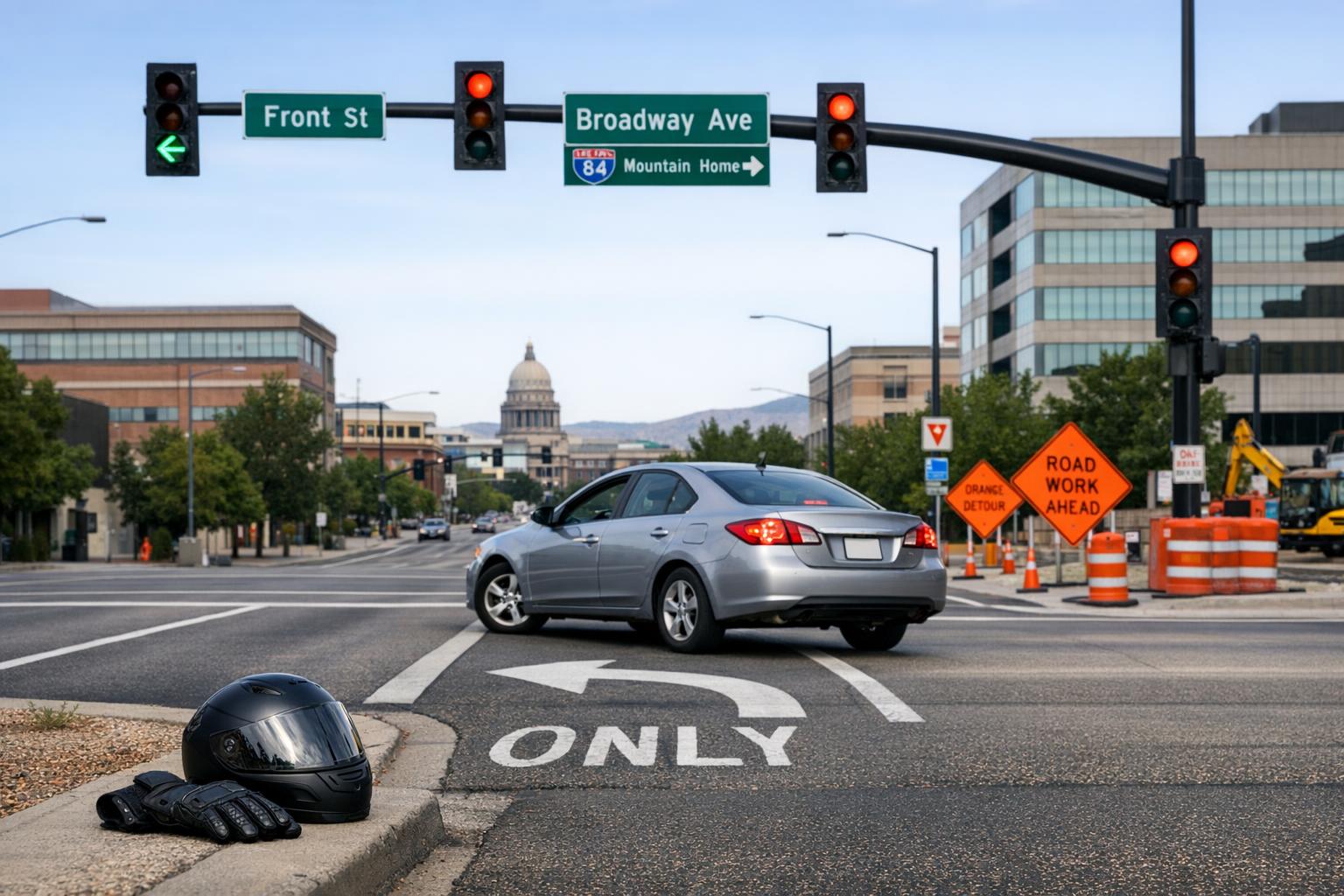
- Why left turns are one of the most dangerous moments for Boise riders
- What counts as a “left-turn motorcycle accident” in Boise?
- Fault basics
- How insurance companies often try to shift blame in left-turn motorcycle claims
- Evidence checklist
- Did you know? Quick facts riders and drivers miss
- Step-by-step
- A Boise-specific angle
- Talk to a Boise-area injury lawyer about your left-turn motorcycle accident
- Frequently Asked Questions
- Glossary (Plain-English)
Why left turns are one of the most dangerous moments for Boise riders
A driver “just turning left” can change a motorcyclist’s life in seconds. In Boise and across the Treasure Valley, left-turn crashes often happen at everyday intersections—during commutes, errands, or the last mile home. These collisions can also become legally complex fast: drivers may claim they “didn’t see” the motorcycle, insurers may question speed or lane position, and crucial evidence can disappear within days.
What counts as a “left-turn motorcycle accident” in Boise?
A “left-turn motorcycle accident” typically describes a crash where a vehicle turns left across a rider’s path. The most common scenario is a driver facing oncoming traffic who turns left at an intersection or into a driveway while a motorcycle is traveling straight through. Another common setup is a driver pulling out from a side street or parking lot and cutting across lanes.
In fault analysis, Idaho’s rules of the road matter. Under Idaho law, a driver intending to turn left must yield the right-of-way to an oncoming vehicle that is in the intersection or close enough to be an immediate hazard.
Fault basics: why “I didn’t see the motorcycle” isn’t a defense
Many left-turn crashes come down to attention, timing, and judgment. Even if the driver claims the motorcycle “came out of nowhere,” the legal question often becomes whether the driver turned when it was not reasonably safe to do so and whether they yielded when required.
Idaho also requires that a driver only turn or move right/left when the movement can be made with reasonable safety and after giving an appropriate signal.
How insurance companies often try to shift blame in left-turn motorcycle claims
In Boise, left-turn motorcycle accidents, insurers commonly look for ways to reduce payout by arguing the rider shares fault. Some of the most common allegations include:
- Speed: claiming the rider was traveling too fast for conditions.
- “Lane positioning” arguments: suggesting the rider was “hidden” by traffic or outside the driver’s view.
- Signal/visibility claims: implying the motorcycle had inadequate lighting or the rider was hard to see.
- Timing disputes: arguing the driver began the turn first, or the rider “should have stopped.”
This is where objective proof matters more than opinions. A strong claim is built on evidence that shows distance, timing, and right-of-way—especially at intersections with heavy traffic patterns.
Evidence checklist: what helps prove fault after a left-turn motorcycle crash
If you’re able (or have someone help you), the goal is to preserve what the intersection looked like right then—before vehicles move, skid marks fade, and camera footage is overwritten.
| Evidence Type | Why It Matters | Best Time to Get It |
|---|---|---|
| Intersection photos/video | Shows lanes, sight lines, traffic controls, debris, skid marks, and final rest positions | Immediately (same day if possible) |
| Witness names + numbers | Independent accounts can counter “the rider came out of nowhere” narratives | At the scene (before people leave) |
| Police report / incident number | Documents parties, conditions, statements, and any citations | Same day; request as soon as available |
| Camera footage (businesses, traffic cams, dashcams) | Often the clearest proof of who entered first and whether the turn was safe | Within days (footage may be overwritten) |
| Medical records and symptom timeline | Connects the crash to injuries and supports compensation | Start immediately; continue consistently |
If the collision happened at a signalized intersection, the driver’s duties may also be shaped by signal rules (including yielding to traffic and pedestrians lawfully in the intersection).
Did you know? Quick facts riders and drivers miss
Step-by-step: what to do after a left-turn motorcycle crash
1) Get medical care first (even if you “feel okay”)
Adrenaline can mask injuries like concussions, back/neck trauma, or internal injuries. Prompt care protects your health and creates timely documentation.
2) Call law enforcement and request an incident number
A report is not the final word on fault, but it can preserve names, locations, and early statements that become important later.
3) Document the intersection, not just the damage
Wide shots showing signals, signage, lane arrows, and sight lines can help reconstruct how the turn happened—especially in left-turn disputes.
4) Be careful with recorded statements
It’s normal to feel rattled, confused, or unsure about timing and distance right after impact. If an adjuster pushes for a recorded statement immediately, it can lock you into wording that doesn’t match later evidence.
5) Watch the clock: Idaho’s filing deadline can be short
Many Idaho personal injury lawsuits must be filed within two years. Waiting too long can limit your options—especially if you need crash reconstruction, medical specialists, or video preservation.
A Boise-specific angle: intersections, growth, and construction traffic
Boise’s steady growth means more congestion, more turning movements, and more drivers navigating unfamiliar routes—especially near major corridors and commercial areas. For construction managers, contractors, and business owners who ride, this risk can be amplified by:
- Work-zone lane shifts that change “usual” turn lanes and sight lines.
- Delivery vehicles and large trucks creating visibility blocks at intersections.
- Time pressure during early morning starts and late-day commutes.
If a left-turn crash happens in or near a construction area, documenting signage, lane markings, and temporary traffic control can be especially important for determining how—and why—the collision occurred.
Talk to a Boise-area injury lawyer about your left-turn motorcycle accident
If you were hit by a left-turning driver in Boise, Meridian, or anywhere in Ada or Canyon County, getting guidance early can help preserve evidence, reduce insurance pressure, and map a clear path forward.
Note: This page is for general education and isn’t legal advice for your specific situation.
Frequently Asked Questions
Who is usually at fault in a left-turn motorcycle accident in Boise?
Often, the left-turning driver is responsible because Idaho law requires a driver turning left to yield to oncoming traffic that is in the intersection or close enough to be an immediate hazard.
What if the driver says I was speeding?
Speed allegations are common. The outcome often depends on objective evidence like video, witness statements, vehicle damage patterns, and scene measurements. Even if speed is disputed, a driver can still be at fault for turning when it wasn’t reasonably safe.
How long do I have to file a motorcycle injury lawsuit in Idaho?
Many Idaho personal injury claims must be filed within two years. Exceptions can apply, so it’s smart to confirm deadlines quickly.
Do I have to accept the insurance company’s first offer?
No. Early offers may arrive before you fully understand the medical outlook or long-term effects (especially with back/neck injuries). It’s reasonable to seek legal guidance before agreeing to terms that close your claim.
Glossary (Plain-English)
Explore more about Shep Law Group’s services: Practice Areas or reach the team directly via Contact Us.